The internet is a wondrous thing. While googling Prince Saunders, this enlightening interview with Alcenat, an academic who is studying him, appeared. In addition to discussion Prince Saunders as a historical figure, the interview also covers African American emigration to Haiti in the 19th century, an area of interest to this blog. Although I have looked into the subject of Prince Saunders as part of my larger interest in African American/Haiti connections, Alcenat's work promises to unveil new discoveries about Saunders. I too am interested in him, especially what kind of role did he play with the African American emigration waves of the 1820s, under Boyer. But it's also relevant to discussions of black nationalism as an ideology among African Americans and black emigrationism.
Showing posts with label Prince Saunders. Show all posts
Showing posts with label Prince Saunders. Show all posts
Thursday, October 29, 2020


Thursday, July 18, 2013
Pompée Valentin de Vastey Part 2: Essai sur les Causes de la Révolution et des Guerres Civiles en Haïti (1819)
So far, the only English translation of one of his texts I've uncovered, Essai sur les Causes de la Révolution et des Guerres Civiles en Haïti (An Essay on the Causes of the Revolution and Civil Wars of Haiti), 1819, translated by W.H. and M.B. It can be found here and is in public domain. The text best illustrates the truth the Ishmael Reed's "writin' is fightin,' since Vastey is fighting for Haiti and people of African descent the world over in his essays and pamphlets, which Dubois asserts were read and discussed in European newspapers. His venom toward Petion for the latter's unfavorable negotiations with France are scathing, too! Check this out, from page 8, in the introduction:


 (58)
(58)
 (119)
(119)


Vastey accuses Petion and his followers of treason for these deals! Unsurprisingly, Vastey also writes about the ex-colonist lobby in the French government, and the ill-informed, racist French news, which sought to paint Haitians as savages and push France to go to war (11). Basically, fake journalism and interests of ex-planters portraying Christophe's rule in negative light have led to Vastey's essay, which begins the first chapter explaining the background to the Haitian Revolution and why Haitians sought independence. His basic statements on Saint Domingue are brief but accurate. In fact, 20th and 21st century accounts of the preamble to the Haitian Revolution sound much like this account. Here is an example of Vastey's succinct description of colonial society from page 17:

Oge and Chavanne are given their due for helping to ignite the Haitian Revolution, the exploitation and manipulation of black and colored generals and warriors for France, Spain, and used by France against each other (Toussaint Louverture and Rigaud, the latter encouraged by Hedouville). He's also critical of Toussaint for only nearly declaring the independence of Saint Domingue, as well as some harsh words for the south of Haiti for so easily accepting Napoleon's troops on page 27:

Apparently Toussaint's brother, Paul surrendered the Spanish-speaking portion of the island to the French without a fight, falling prey to the ideas of Bishop Mauviel and Kerverseau (28). On the issue of color and divisions among generals during the Haitian Revolution, on page 39 Vastey clearly leans toward the Black Generals, who he claims never fell for the lies of the whites as much as the men of color:

Such statements add needed nuance to claims about race and color in Haitian identity, since Vastey, a member of the mixed-race ancien libre, who studied in France, so strongly identified with Christophe and 'black' generals. Subsequently, the chapter on Dessalines defends the leader as favorably disposed toward men of color (45):

Unfortunately for Dessalines and Haiti, Vastey writes that by placing his capital not in Port-au-Prince, Dessalines was less cautious of the south and west of the country, and therefore more suspectible to defeat in civil wars or coups (45). He also admits the glaring contradictions of the emperor's constitution, and states that it was pardonable given the youth of the nation, suggesting in retrospect that a constitutional monarchy would have been better (47). Vastey's hositility toward Petion, a traitor to the Haitian cause, is seemingly justified if Vastey is correct to note that Petion plotted with Haitians from abroad (who were allowed to return by Dessalines) to make Petion the head of government (49). Petion's role in assassinating Dessalines, a man who fully trusted him, is beyond disgusting. To quote Vastey, "Thus did Petion accomplish the destruction of his Sovereign, his friend and benefactor, in order to seize the reins of government, and kindle anew the flames of civil war" (56). He also provides an excellent character analysis with obvious bias in the fourth chapter:
(58)
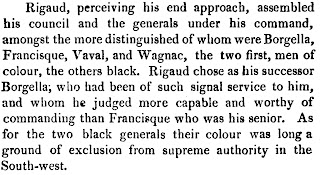
The rest of the text focuses on the various civil wars and conflicts, such as that of Goman versus Petion, Christophe and the North versus Petion's South, Goman's relationship with Rigaud (his godfather), and hurls criticism toward reductionist stereotypes of the color complex in Haitian society (93). There's also room for criticism of Rigaud's regime in the South-west:
 (119)
(119)
Meanwhile, Christophe saw to the uplift, safety, and governance of the North ofHaiti while Petion engaged in battles and political conflict with Rigaud and others (100). He goes on to defend the monarchical form of government, and how representative constitutional monarchies can evade tyrants (he cites the example of Robespierre for an example of how a republican form of government can turn tyrannical, 106). In addition, the reality of French plots against Haiti does seem to be a constant presence in the writings of Vastey, even if an actual French military invasion was unlikely and too costly for France in the first decades of the century. After several pages of descriptions of the conflicts between the warring generals and officials, Vastey drops an appropriate, 'Afrocentric' claim on p. 137:

The rest of the essay merely argues over and over again how Petion fomented civil war and disunity among Haitians, was a savage, ruthless and ineffective ruler who faced an assassination attempt. His pseudo-republican title combined with despotic rule are also up for criticism to Vastey (205). Ultimately, his criticism of Petion and even Boyer near the end for succeeding like Roman emperors through the Praetorian Guard, endeavors to vindicate the state of Christophe as a better representative of Haitian independence, liberty, and black progress through schools, constitutional monarchy that is stable, and a strong stance on resisting French plots against Haitian sovereignty and freedom. Whether or not one believes all of Vastey's critiques is another question, since, like the apologists of Petion's regime, he was expected to paint Christophe and the North in a positive light. Unfortunately for this significant figure in Haitian intellectual thought and political writings, Vastey found his end in a rather nasty way after Christophe's death and Boyer's regime, which carried on the practices of Petion while closing down Christophe's schools. But the overall message of the text is that the causes of the civil wars of Haiti in this period were due to French white interference and manipulation, men of color such as Petion or Rigaud willingly making or negotiating deals against Haitian independence and black generals, and their despotic, exclusivist rule that led to further conflict along color and ideological lines. Based on what happened after Petion's death and the regressive rule of Boyer for over 20 years, one definitely sides with Vastey in some ways.
Wednesday, July 17, 2013
Prince Saunders and the Haytian Papers (1816)

"Descendants of Africans, my brethren, the friends of humanity have asserted that we are susceptible of improvement like the Whites; our traducers affirm the contrary; it is for us to decide the question; it is by the wisdom of our conduct, our success in the arts and sciences, that we shall secure the triumph of our respected and illustrious patrons, and confound, forever, the malice and unfounded assertions of our implacable enemies" (223).
Perusing the Haytian Papers, translations of Haitian edicts and documents under King Henri Christophe by Prince Saunders, an African-American educator, one comes across in Saunder's introductory comments allusions to the remarks of white racists that none of the kingdom's writings were penned by blacks or men of color! To white supremacists and pro-slavery folks, the very idea of an independent black state with literate people of color writing their own laws was impossible! The Code Henri immediately also goes into detail the progressive, anti-oppressive laws regarding labor relations: "The proprietors and farmers of land are bound to treat their respective labourers with true paternal solicitude; an obligation which it is greatly for their own interest to fulfil in its utmost extent." Code Henri includes requirements for hospitals on plantations, medical service, and the right of government officials to mediate conflicts between workers and landholders. Chapter II's Art. XVII. also empowers the state to force one into labor: "The law punishes the lazy and vagabond, among whom are comprehended labourers of both sexes who shall quit the habitations in which they have domiciled, in order to reside in towns or other places where they are forbidden to settle: penalty, Art. 114. Titre 8." Although perhaps a little too confining in the movement of ex-slaves, and setting them to a work schedule from daylight to sundown may have been too reminiscent of slavery, clearly the laws (at least written laws, how they were enforced would be an even more interesting question) were far more progressive and interested in the welfare of the majority of the population.
Other documents contained therein include correspondence between Christophe and Leclerc, the former stating he cannot recognize the authority of a person he does not know and lacks recognition from governor Toussaint Louverture (8). Another, Narrative Of the Accession Of Their Royal Majesties To The Throne Of Hayti," endeavors to explain how Christophe rose to position of king. It includes a scathing comment on the French as "Vandals who have ravaged every country into which their well-known footsteps have strayed" (55). As one would expect, such a document is full or propaganda and hyperbole, which comes out strongly its it description of the Haitian navy as the "terror of tyrants" or whitewashes the dark collaborations of Christophe with others against Dessalines. The document also alludes to Citadel Henry and Sans Souci as a beautiful town built to great expense. The writer apparently thinks highly of Abbe Gregoire, too, particularly for his Literature of the Negroes and openly avenging the blacks for their wrongful suffering because of the racist beliefs of France (84). The short-lived return of Rigaud and internal dissension against Petion naturally occupies a lot of pages, as well as the latter's willingness to entertain compensation for France come into the propaganda.
Additional documents provide another look at how the kingdom of Christophe was conceived, with a royal family, Grand Council, Privy Council, Great Officers, the four ministers, etc. The document also endeavor to justify a monarchy with allusions to the "paternal monarchial government" associated with Montesquieu, while simultaneously recognizing the federative system of government of the United States as another model. Praise for Haiti and the land and people as sufficient for a kingdom also comes out through great lines such as this, "We say nothing as to the same martial valour and heroic character of the Haytian people: its glory is known throughout the world!" The "Manifesto" of Christophe also has some things to say about Toussaint Louverture:
Always intent upon the work of restoration, the Governor, Toussaint Louverture under his paternal administration, had reinstated, in full force, law, morals, religion, education, and industry; agriculture and commerce were flourishing. He favoured the white colonists, particularly the planters. Indeed, his attentions and partialities had been carried to such a length, that he was loudly blamed for entertaining more affection for them than for those of his own colour. Nor was this reproach without foundation; for, a few months before the arrival of the French, he immolated his own nephew, General Moyse, who had disregarded the orders he had given for the protection of the colonists. That act of the governor, added to the great confidence he had placed in the French authorities, was the principal cause of the feeble resistance the French encountered in Hayti (158).
Christophe's state also declared, "We solemnly declare, that we will never become a party to any treaty, to any condition, that may compromise the honour, the liberty, or the independence of the Haytian people; that, true to our oath, we will sooner bury ourselves beneath the ruins of our native country, than suffer an infraction of our political rights" (182).
Finally, the "Reflections of the Editor" has some rather strong words for Petion, who is accused of negotiating Haitian independence for a colonial relationship with France (certainly not true), while later documents allude to the ancient Egyptian, Ethiopian and other black ancestors of Africa whitewashed by racist detractors of the blacks and proponents of slavery (219). The documents end on a rather high note, calling for education in the arts and sciences to improve Haiti and in the process prove again the equality of the black race to the whites. Unfortunately, though such government records are revealing of the atmosphere of Christophe's court at the time (in particular, their interests, priorities, and propaganda), they reveal too little about the lives of the subaltern masses in Christophe's kingdom, though evidence from Dubois and other secondary sources indicates the spread of education, among thousands of Haitian children in Christophe's kingdom. Prince Saunders, clearly compiling these documents to show the British and other readers the progress Haiti made under Christophe, was a firm believer in Haiti as the paradise for blacks in the hemisphere, choosing to live in Haiti even after the fall of Christophe and Boyer closed all the schools, according to this. That he was an educator and helped to establish Christophe's schools, oversaw them and assisted in bringing British teachers and specialists (Saunders also introduced vaccination into Haiti, beginning with Christophe's children) adds credibility to his Haytian Papers, as well as revealing to depths to which he himself would later identify as Haitian instead of choosing a life of 'freedom' in the antebellum US. Indeed, Fanning's research reveals the extent to which many free blacks of the US looked to Haiti as a model and potential home, so Prince Saunders was not alone in settling in Haiti or serving to spread education and uplift the people.
Subscribe to:
Posts (Atom)