Showing posts with label Encomienda. Show all posts

Wednesday, November 12, 2025

The Afterlife of Marien


Whilst perusing the very helpful tables of Arranz Marquez in Repartimientos y encomiendas en la Isla Española: el repartimiento de Albuquerque de 1514, we came across 5 caciques with "del Marien" in their names. None of them were linked to encomenderos in Puerto Real, the Spanish colonial city founded near the likely site of Marien's capital. Thus, within about 22 years of first meeting Columbus, the population of Marien was severely displaced and likely experienced high amounts of death through disease, forced relocation, disrupted food supply, and forced labor. Guacanagari's people were now spread around in La Concepcion and Bonao. In the latter town, a surprisingly high number of Indians tied to the Marien caciques Torres del Marien (170 indios) and Velazquez del Marien (70) were laboring for Juan de Ampies. In La Concepcion, 3 caciques from Marien were listed: Antonio Escobar del Marien, Barahona del Marien and Cristobal del Marien. The indios linked to them numbered 117. This suggests that by 1514, Marien (presumably its "core" had about 317 indigenous people who had been relocated through the encomienda system. Over half of this group ended up in Bonao. In Puerto Real itself, where it is probably safe to assume much of the indigenous population was from the old cacicazgo of Marien due to the absence of gold mining, it is difficult to trace where the caciques and their communities came from. 

In one case, that of Francisquillo de Bayaha, we can presume he was from the area of modern-day Fort Liberte. The cacique called Mayordomo de Hatiel may have come from a region that appears in the Morales map to be south of the Artibonite and east of its mouth. This area may not have been part of the Marien cacicazgo. According to Bernardo Vega, it likely covered the territory from Borgne to Monte Cristi.It is unlikely for the area south of the Artibonite to have been part of Guacanagari's spheres of influence. In the case of Diego Aynaguana, however, it is somewhat ambiguous. The cacique Diego Aynaguana in Azua may have been relocated there via the encomienda system. Once again, the Morales map provides a clue since it appears to identify a river called Aynagua northeast of Puerto Real. If so, that means at least 349 Indians were forced to relocate from the environs of Marien. 

And of the caciques in Puerto Plata and other regions, a few may have been linked to the period of Guacanagari's rule in the 1490s. One cacique from Marien went by the name Cristobal. Was this possibly in reference to Columbus? Another cacique, Juan de Manuy, was assigned to an encomendero married to a native woman, Gonzalo de Arevalo. We were unable to find out when he came to the island, but if his wife was from this part of the island, he may have used her kinship ties and connections that may have preceded 1492 and the calamities of the colonial conquest. Furthermore, the one cacique assigned to a Puerto Real encomendero with more than 100 Indians was a man named Fernando Guanabax. We know from Peguero and Oviedo that a relative of Guacanagari traveled to Spain with Columbus on his first voyage. He was baptized there and took the name Fernando de Aragon. Is there any chance Fernando Guanabax was the same man? We admit this is pure speculation and quite unlikely, but he was the only cacique with more than 100 followers in the Puerto Real area.

As for the area around Lares de Guahaba and Haiti's northwest, we are unsure. Las Casas seemed to exclude Guahaba and Amaguey (near modern Gros Morne?) from Guacanagari's Marien. Charlevoix, writing in the 18th century, believed Marien covered all of the north coast from Cap St. Nicolas (Mole St. Nicolas) to Monte Cristi, as well as a part of the northern Vegal Real. Moreau de Saint-Mery echoed that sentiment, including Port de Paix as once in the domain of Guacanagari. Indeed, he even believed the Artibonite was the southern border for Marien, implying Guahaba would have fallen under Guacanagari's control or influence. In the next century, Haitian historian Emile Nau also wrote of Marien including Guahaba and the western limits of the Artibonite (Nau, 36). Perhaps even more boldly, the Haitian author Gilbert Valme added Tortuga to Guacanagari's territor (Valme, 229). Interestingly, the remaining indigenes of Tortuga were assigned to an encomendero based at Puerto Plata in c.1514. In terms of other modern scholars, Deagan, the archaeologist who has presented the best case for identifying En Bas Saline as Guacanagari's capital, similarly included Guahaba in his land (Deagan, 240). 

Until scholars uncover new sources, the mystery of Marien's end will continue. Scholars have different theories on the death of Guacanagari, for example. It would appear that he was likely dead within 10 years after meeting Columbus. And while his capital was likely occupied until the 1520s, it too was eventually abandoned. With about 317 Indians from Marien serving encomienda holders on the other side of the island in 1514, one can imagine high mortality rates and labor exploitation wiped out much of the remaining population. Even Puerto Real itself was later disbanded. But if 317 Indians from Marien were enumerated in 1514, scholars might be able to reach more accurate population estimates of the region's population in 1492. To what extent Guacanagari was able to control other provinces is up for debate, but the large plaza and public architecture at his capital suggest he was not such a minor or subordinate cacique after all. Indeed, Las Casas personally claimed to have met several of Guacanagari's vassals who were of high standing, presumably meaning caciques and nitainos who occupied more than the region near En Bas Saline. 

Saturday, September 21, 2024

Pedro de Espinosa


While perusing an article by Burset Flores on the pattern of men marrying local women from established families to become wealthy in colonial Puerto Rico, we dug a little deeper into the origins of one woman involved in such a marriage. According to his research, this woman, Juana Manso de Espinosa, was a descendant (granddaughter) of Pedro de Espinosa, a regidor of San Juan and son of an early poblador of the island, Juan de Espinosa. Juan de Espinosa was apparently the recipient of an encomienda of 50 Indios (30, according to Esteban Mira Caballos) in 1511, supposedly from the territory of the cacique Azmia. Pedro de Espinosa, his son, also led one of the raids on the territory of the cacique Orocoviz in 1513, according to Moscoso's Caciques, aldeas y población taína de Boriquén (Puerto Rico), 1492-1582. By 1530, according to the "census" of de Lando (which enumerated vecinos, slaves, and "free" Indians in San Juan and San German), Pedro de Espinosa had 6 Indian slaves (non-native) and 17 naborias. While the census of 1530 was hardly an adequate tally of the total population of the island, it is clear that Pedro de Espinosa, who may have inherited the encomienda Indians of his father, had less than half of the total Indians his father supposedly received in 1511 from Ponce de Leon. 

The demographic collapse of the indigenous population was likely following similar trends already evident in Hispaniola by 1514. One also cannot avoid acknowledging the huge imbalance in gender ratios among the population on the island, with Julio Damiani Cósimi's Estratificación social, esclavos y naborías en el Puerto Rico minero del siglo XVI. La información de Francisco Manuel de Lando. Ensayo de cuantificación y transcripción paleográfica finding disproportionately male slaves in San Juan and San German for both Amerindian and Africans. Presumably, since the Spanish were used to slavery and concubinage even before the conquests in the Antilles, many of the vecinos and other white men had indigenous and African women as partners. Indeed, some vecinos were even married to indigenous women (although not to the same extent as the 1514 Albuquerque Repartimiento of Hispaniola revealed). Julio Damiani Cósimi's transcription of the "census" indicates this gender imbalance and how Puerto Rico was already a slave society by 1530. It was this disturbing basis of wealth and power that paved the way for a soldier named Francisco Delgado to marry into money and status in the second half of the 16th century.

Saturday, December 9, 2023

Conditions of Encomienda Indians in Puerto Rico


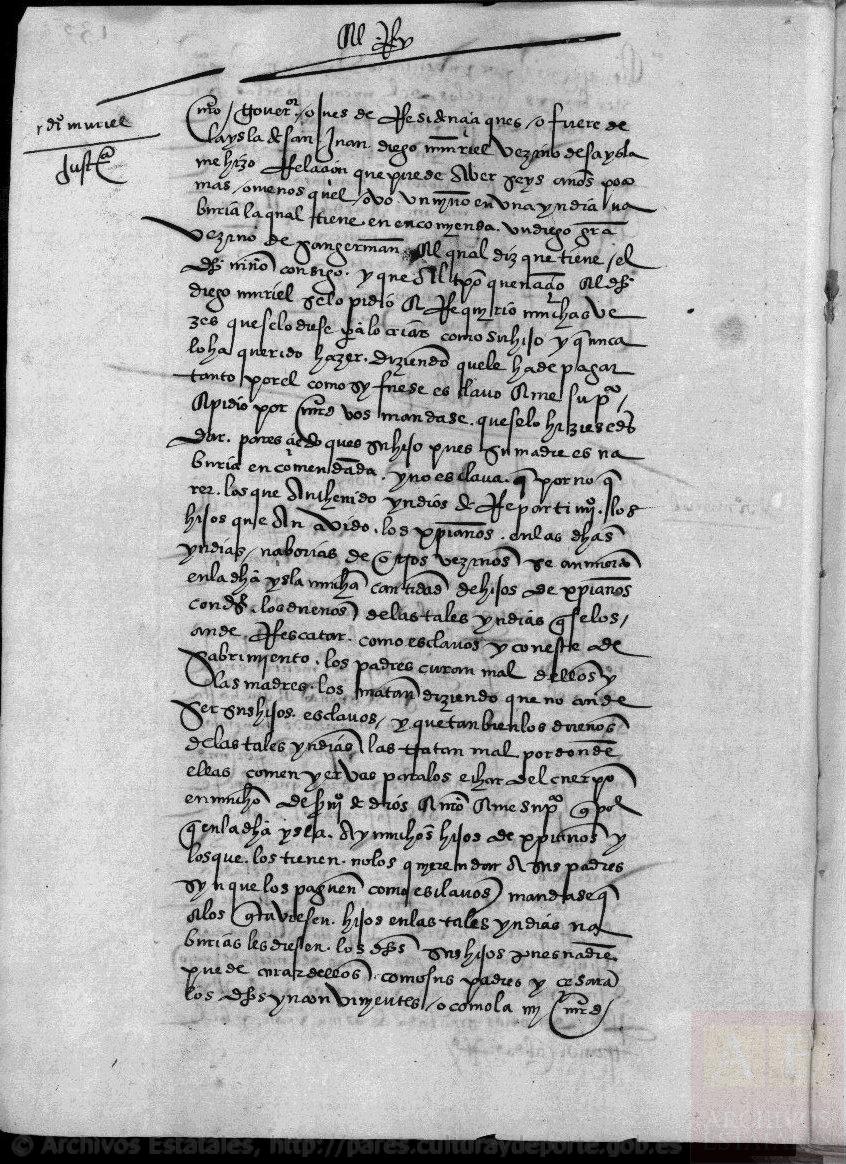
Another mention of Diego Muriel digitized at PARES contains some very interesting information on the Indian laborers of  the royal Hacienda of Ribera de Toa in 1528. Established with indigenous Puerto Rico caciques and Indian laborers, the document provides some powerful testimony about the exploitative conditions in which Indians in the encomienda system toiled under. Reading between the lines, one can surmise that the "Taino" of Puerto Rico, at least in this hacienda, were scarcely acculturated into Spanish ways. The document lists the improved treatments to be given to the Indians, including ensuring their indoctrination in the Catholic faith and having access to Mass twice per week. One can probably conclude that before 1528, and perhaps after this year, they were not devout or deeply Catholic. In addition, the stipulation that Muriel see to it that the Indians understand marriage and cease the practice of males shifting to different women suggests the indigenous laborers were not following Spanish or Catholic norms of marriage and domestic organization. 

The other proposed methods to improve the treatment of the Indian workforce included the provision of meat, hammocks or blankets, and additional clothes. Perhaps the population was still wearing Indian-styled clothing of enaguas and whatever they received for use during worktime. Overall, this suggests an indigenous population that was probably maintaining older, precolonial practices in religion, spirituality, diet, and dress to whatever extent that was still possible in 1528. As Guitar revealed in her dissertation on Tainos of Hispaniola, the indigenous population in Puerto Rico was probably still practing their areytos, cohoba rituals, and the ballgame, too. Unfortunately for us, however, no one recorded more of the traditions, areytos, or customs of the Puerto Rican Indian that may have given us far more information on precolonial, pre-Hispanic history. But the thin or superficial conversion and Hispanization of the indigenous population definitely explains why their legacy is so strong in Puerto Rico and the Spanish Caribbean. 

Wednesday, December 6, 2023

Diego Muriel's Mestizo Son


The story of Diego Muriel is a disturbing one. Before marrying the cacica of Caguas, he fought for the rights to his mestizo son. The issue was the mother was a naboria india, held in an encomienda by Diego Garcia in San German. Diego Garcia only wanted to give Diego Muriel his son for a price, selling him like a slave. Diego Muriel took the case higher up in government to resolve it, and we sadly do not know the results. However, the fact that this occurred to begin with is suggestive of the few distinctions between naboria and enslaved Indians at this time (1528). Similar scenarios probably occurred elsewhere in the Spanish Antilles of this era, as white men sometimes had relationships with women they did not control. What is even more interesting is that this 1528 document seems to suggest that children in similar situations were often abused by the encomienda owners. 

Monday, August 7, 2023

Encomiendas and Indian Slavery in Puerto Rico

Eugenio Fernandez Mendez's Las encomiendas y esclavitud de los indios de Puerto Rico, 1508-1550 is a brief study of the forced labor and coercion in the first half of 16th century Borinquen. Drawing primarily from the Spanish chroniclers and sources such as those compiled in Tapia's Biblioteca de Puerto Rico, this short book focuses on the Spanish conquest and the various repartimientos and divisions of Indians into encomiendas until the final dissolution of the encomiendas. Unfortunately, by c.1550 their population was decimated and devastated by the encomiendas and outright enslavement. "Carib" and Indian slaves from Yucatan, Panuco, or Tierra Firme were still not enough to address the labor shortages and other problems facing the colony. However, the indigenous population of the island survived and went on to form part of the Puerto Rican population. Fernandez Mendez cites sources attesting to an Indian presence larger than that asserted by Rodrigo de Bastidas for the 1540s. Indeed, even after the Laws of 1542, illegal enslavement of Indians continued. These and other "free" Indians not enumerated in the 1540s undoubtedly persisted, helping to explain some of the markedly "Indian" features in Puerto Rican culture long after the demise of encomiendas. What would have made this study more valuable would have been an examination of Taino resistance to the encomiendas after the 1511 rebellion. Perhaps a deeper look at indios alzados and African slave rebels could have shed light on this other dynamic in 16th century Puerto Rico.