This short video is a useful introduction to the Samana Americans of the Dominican Republic. It's interesting as an example of how some older Samana Americans recall their origins. One can detect the influence of Dominican nationalism, assimilation, and schooling has shaped the history of their community in Hispaniola. For example, the older woman who speaks English refers to problems with Haitians as part of the reason many African Americans left the island, partly due to religious differences. She explicitly alludes to Roman Catholicism as one of the problems, despite most Dominicans of the era also being nominal Catholics. Indeed, unlike previous generations, these Dominicans lack the condescending attitude of their settler forebears, who saw Dominicans as lazy and had limited cultural contact with them. After hearing the two elderly Samana Americans speak, I am more inclined to believe the success of the Samana settlers may have had more to due with the isolated nature of their settlement. This allowed them a degree of community autonomy that may have been lacking in Haiti, which had a greater population density that probably impeded the forms of communal autonomy the Protestant African Americans desired. The fact that most also received land and did not have to sharecrop or sell their labor on estates probably helped. The successful African American emigration to Haiti proper, however, was urban. Their descendants were able to retain some degree of separate identity, but the urban experience likely weakened any isolationist community attempts.
Showing posts with label Boyer. Show all posts
Showing posts with label Boyer. Show all posts
Tuesday, September 10, 2019


Thursday, February 14, 2019
Zoune chez sa ninnaine: fan'm gain sept sauts pou li passé
With novelists such as Justin Lhérisson, it becomes easier to see the literary traditions of Haiti over the last century. Utilizing lodyans and incorporating Creole dialogue allowed Lhérisson to explore language, class relations, society, and culture in a playful manner. Zoune chez sa ninnaine has a wonderful sense of humor, which brought to mind more contemporary Haitian and Caribbean writers. Lhérisson, in this novel, addresses a number of social ills plaguing Haiti during the Boyer years, juxtaposing Zoune and her travails with her godmother and Cadet Jacques to the anti-Boyer movement of Hérard Dumesle and the miserable conditions in the countryside, where Zoune's peasant parents lived.
The novel begins with a description of her parents, the miserable conditions Zoune experienced as a sickly and tired child and, eventually, their plans to baptise her several years after her birth due to superstitious fears. This, eventually, leads them to having to find a godmother for their child. They later send Zoune to live with this well-to-do woman, Madame Boyote. Thanks to Boyote, Zoune recovers from her emaciated, sickly condition and develops into a beautiful young woman. Boyote sees to it that she receives first communion, gives her some education (at a time where, according to the narrator, there were maybe 19 or 20 primary schools on the entire island), and employs her in her business.
However, the growing prosperity of Boyote attracts negative attention from envious rivals and people with nothing to do. Lhérisson satirizes in a hilarious manner the social evils of Haiti as many city residents try to destroy Boyote through rumors of sorcery, magic, lesbianism, and more. The humor continues with the infamous Cadet Jacques, a military man of many mistresses. He will go to extreme lengths in his sexual conquests, including abusing his powers to coerce young women to sleep with him (such as arresting their families). In fact, Cadet Jacques justified his behavior by pointing to President Boyer, a man who also had several mistresses, which the narrator uses as an opportunity to lament the lack of role models among Haitian leaders. Lhérisson probably did believe that with education and moralisation, the peasantry and lower classes could excel, but corrupt leaders like Cadet Jacques ensure ignorance, misery, or suffering prevail.
The rest of the story is well-known. Beautiful Zoune attracts several male admirers, including Cadet Jacques, who takes Boyote as his mistress. Her business grows more prosperous, but Cadet Jacques begins making inappropriate passes at her goddaughter. Eventually, he tries to rape her. Later, the entire city finds out about the affair and Zoune leaves her godmother, pursuing a life on her own. A number of social problems are raised throughout the book, particularly the exclusion of peasants from the "citadins" in Port-au-Prince, class relations, the limited spheres for women, and the misrule of Boyer.
What particularly stands out, however, is Lhérisson's use of humor to convey social commentary. Golimin, the narrative voice, as well as the characters themselves, speak in French, Creole, and, in some cases, creolized French. Frere Philomène's creolized French at Zoune's first communion celebration, for instance, demonstrates the creative ways language can be modified to more closely capture the Haitian reality. The Creole phrases, proverbs, insults, and modifiers inject an oral breath of life to the dialogue (including music) while also illustrating nuances in social relations. The novel abounds in references to sorcery, nicknames, popular beliefs and the religious melange of Catholicism and Vodou, bringing to mind the way subsequent authors like Laferrière are indebted to Lhérisson's generation. This is all quite creative while entertaining Haitian audiences a few years after the Centennial of the same ongoing problems. Sadly, it remains relevant in the 21st century, too.
Monday, July 28, 2014
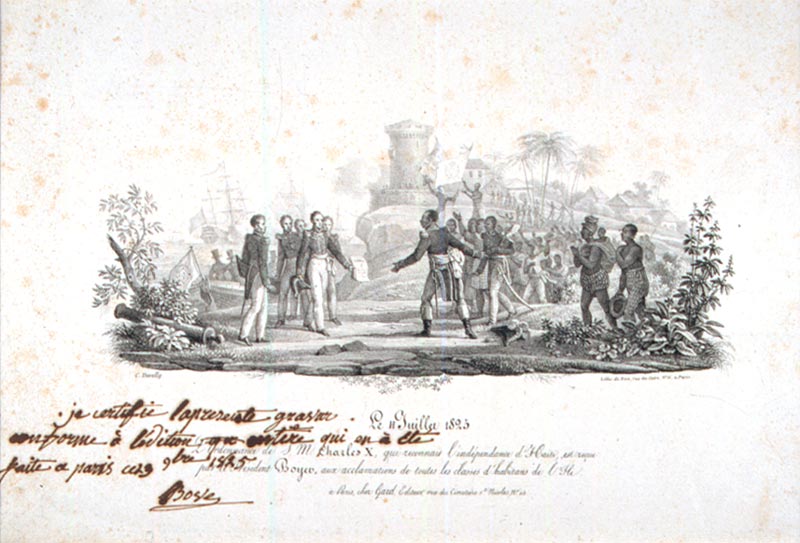
Charles X and Haitian Recognition (1825)
.png)

Some images of French recognition of Haitian sovereignty during the reign of Charles X. One can see quite clearly the paternalism of the French artists in depicting this event, which also seems to be partially based on common imagery of slaves in abolitionist propaganda. This period began the 'debt crisis' of Haiti and a great example of foreign imperialism, although Boyer's government and that of his predecessor seemed to favor some sort of indemnity to France without heavy French military threats.

Tuesday, December 17, 2013
Jonathas Granville

Jonathas Granville was one of the agents sent by Jean-Pierre Boyer to attract free African-American settlers to Haiti in the 1820s. It's interesting to see what the man looked like, although it does little to change my views of the Boyerist clique as disproportionately lighter-complected than the Haitian people, due to their interest in monopolizing political power. According to Wikipedia, the brother even married a cousin of Boyer, showing how interconnected all these Boyer elites were through blood, kin, and color (but the Wiki lacks proper citations).
I have blogged about the 1820s movement of 6,000-13,000 free blacks to Haiti here, but Pamphile offers some additional data on the 1820s emigration experiment that was an abysmal failure. According to him, Boyer emphasized how similar Haiti was to free blacks from the US than an unknown and culturally different Africa (even though Haiti would prove to be very different culturally, socially, and linguistically for African Americans), Boyer funded the scheme (via Granville, Dewey, an American Presbyterian minister, and others) with coffee exports on the expectation that free blacks would labor as agricultural workers, and some interest and help from Philadelphia's black middle class and prominent people, such as Bishop Richard Allen. Granville spoke at gatherings for the emigration society, minimized differences between Haitians and African Americans, and left private writings that reveal a rather condescending view of the free people of color of the antebellum US ("“The colored people here are, whatever they say, in such a state of abjection that each time I am with them I feel that their degradation reflect on me.").
As Pamphile and other observers have noted, the emigration of the 1820s was doomed to fail in some key ways First, most of the free black emigrants were artisans and urbanites with no interest in agricultural labor like Boyer and the Haitian state desired. In addition, the cultural, religious, political, and social gap between African Americans and Haitians proved insurmountable to many, at least to one perspective in Port-au-Prince. Moreover, American recognition of Haiti never came, so Boyer ceased funding the migration in 1825! Intriguingly, Pamphile does suggest that blacks from the US who were mulattoes were more successful at integrating themselves into Haitian society, citing Benjamin Hunt to demonstrate how some of the US people of color were mulattoes who were accepted into the class and color structure of Boyer's Haiti. I suppose that last part ain't too surprising, but it certainly increases my interest in black immigrants in 19th century Haiti.
One of these days I'll have to blog about later emigration schemes or parallels in the Liberia/Sierra Leone cases and Haiti. I am certain there are other cases of black immigrants from other parts of the African diaspora to Haiti, such as Felix Darfour (from Darfur but educated in France), blacks from the French Caribbean (Papa Doc himself was of Martinican descent), or the case of slaves from the British Caribbean and "Dominicans."
Saturday, November 2, 2013
Michel-Rolph Trouillot's Haiti, State Against Nation: The Origins and Legacy of Duvalierism
“It must be said in all sincerity that in Haiti, the most productive, the most useful class is surely the peasantry. After all, is it not this class alone that pays taxes? Is it not they who bear all the nation’s costs?”
Finally got around to completing Trouillot's well-written text. The man was a gifted writer unafraid to use the first person or throw in sarcastic and bitter words toward certain figures of Haitian history, such as Beaubrun Ardouin. Ever since I first read his excellent essay on the rise of free people of color planters due to the coffee boom in Saint Domingue a few years ago, and his Silencing the Past was also a thought-provoking read. After his untimely death, I felt reading his Haiti, State Against Nation: The Origins and Legacy of Duvalierism was a must. Furthermore, I heard a humorous story involving him and a former professor of mine traveling in Cuba. Not to speak ill of the dead, but Trouillot apparently recoiled in fear when the two were approached by a beggar in Cuba!
Returning to the text, Trouillot traces the development of Duvalierism before Duvalier to the colonial period and early independent black and mulatto-led governments of the 19th century. Indeed, as he pointed out through a careful examination of the writings of Beaubrun Ardouin, an important figure in Haitian liberalism, Ardouin was the first to articulate a form of despotism in which the Executive held complete control and civil servants were to comply at all times. Furthermore, Trouillot is adamant about the key roles of Petion and Boyer in establishing the pattern in which Haiti became the "Merchant's Republic" where foreign merchants dictated the course of the political system.
Of course, some of the blame for the militarized structure of governance could be attributed to Toussaint Louverture or Dessalines, but, according to Trouillot, Dessalines tried in vain to curb the power of foreign merchants (while urging for capitalist accumulation within the state sector, according to Trouillot) while Petion and Boyer actively courted them and ensured the republic would cater to their needs. This, unsurprisingly, helped fuel merchants cheating the Haitian government, threatening the nation with protective consulships (something Raybaud himself did during the Soulouque years), and worked against the peasantry, the only productive group in Haitian society through indirect taxation on their coffee and other export items at the customshouses (which was unfair for placing favorable duties on luxury goods for elites, hurt peasant producers who received less and less for their coffee and other products but had to pay more for agricultural and other imports from the United States and Europe and the peasantry had few options to resist it, given their exclusion from the towns and cities dominated by the import and export firms acting in collusion with the Haitian state. Indeed, foreign consignment merchants also became powerful in Haiti's coastal towns, including prominent families such as the Brouards, Sutherlands, Prices, and Milroys, who, like the rest of the international trading community in Haiti, "fed on the political, financial, and military instability of the state, and had an objective interest in the rate of political succession, since every regime offered them a new and greedier clique of customers” (72).
In a very similar manner as Dupuy, Plummer, and Dubois, Trouillot illustrates how the Haitian taxation system and death of the plantation economy (despite attempts to revive it, such as during the reigns of Louverture, Dessalines, and Christophe, which Trouillot claims only succeeded due to their black skins and honorable positions as military heroes, surely a position a frequent critic of this blog would disagree with) led to many mulatto elites switching to retail and government to profit of the peasantry and their marginalization in the various dictatorships and military coups that claimed power in Port-au-Prince. Foreign merchants benefited the most from this arrangement, providing loans to the Haitian government to keep it standing while using the threat of US or European invasions to ensure compliance with their demands, hence the violation of Haitian waters dozens of times in the second half of the 19th century.
In this context of European and US contempt for Haitians and the threats and intimidation that went hand in hand with the Haitian elite of all shades preying on the vast majority of the people, it's no surprise that productivity stagnated, the population increased, more and more people moved to the cities and Port-au-Prince especially, and the Haitian economy was trapped in a state of dependence and underdevelopment. Without any capital from taxes used by the state or elite to fund technological innovation (well, except for Geffrard, Salomon, and a few industrialists in Haiti and their foreign partners), combined with the corruption of Haitian politicians using government funds to purchase luxuries they believed were deserved, Haitian levels of coffee exports fell despite rising population and their close trade relationships with the US, Germany, France, and other European powers.
One example particularly pertinent is the estimated 150 million francs in gold Boyer and his cronies squandered from the leftovers of Henri Christophe's treasury. What happened to the money? Presumably, it went into the pockets of Boyer, Inginac, and their other closed circle of mulatto elites and the foreign merchants who supplied them with unnecessary luxurious imports. Or, to quote an example from the Soulouque regime, his appointed nobility numbered in the hundreds and drained the treasury far more than Henri Christophe's underpaid and significantly fewer nobility in the North. Soulouque also spent over 30,000 francs one year for a fine French coat one year, the same as his budget for education! Papa Doc's government had numerous examples from the 19th century for corruption, repression, and poor fiscal policy.
In order to demonstrate the weakness of the landowners in post-emancipation Haiti, Trouillot cites Beaubrun Ardouin himself, writing about his inability to control the movement of workers from his plantation or what they chose to produce and take for themselves! In addition, the black landowners of the North also took to politics and the military to enrich themselves, while the import-export bourgeoisie remained more mulatto-controlled, perhaps due to their closer phenotype to whites. Trouillot does not offer a definitive answer to that, but certainly diplomats discriminated against darker-hued Haitians, why not many white businessmen?
On the color question, Trouillot provides some insights lacking in other accounts of Haitian history and social relations. For instance, from what I can recall, Dubois and Dupuy do not delve deeper in the the demographic signifiance of the clair groups in Haiti today. How could such a small minority of the population from Saint Domingue, who lost signifiant numbers during the Haitian Revolution, still appear so numerous in 20th century Haiti? Of course, the fluctuating boundaries between 'black' and the 'mulâtre' have shifted multiple times, allowing certain people to become 'mulatto' when a century ago, they would have never passed. Indeed, regardless of color classifications or the fact that not just any noir could marry a clair, the question of color among black and mulatto elites in Haitian political history was never about democracy or sharing power with the black masses, something visible in the Duvalier years when the bourgeoisie and handy mulattoes benefited from supporting or accepting Papa Doc and Baby Doc.
The 'color question' and conflicts associated with it in Haitian politics was also compounded by Trouillot's 'urban parasites,' a problematic term but, if I understand correctly, refers to the urban proletariat and servants of the state and other members of the Haitian population not engaged in productive labor but merely waiting and betting on political crises to enrich themselves of serve another dysfunctional state. This system consisting of the political marginalization of the peasantry and accumulation of the urban sector into the political realm was contradictory and made political strife inevitable, which thereby helped 'justify' US occupation for some. This crisis in the system was already almost at its nadir in the 1860s, when Geffrard could not control the countryside, revolts were spreading each year, coffee prices and cotton were down, and Geffrard had to rely on the British to stay in power.
Unfortunately, the pattern did not end, but only grew worse after US occupation centralized the system in Port-au-Prince and removed what Trouillot calls the 'feeble restraints' of the system. Soon, everything was leaving through Port-au-Prince, impoverished peasants and the growing black middle-class were moving to Port-au-Prince and other towns, and the military apparatus was more centralized, too. Papa Doc, from 1957-1964, merely had to neutralize opposition in the government institutions, already conveniently centralized through Port-au-Prince, and then declare himself President-for-Life. Duvalier was following in the more recent footsteps of the repression of Magloire, too, for both persecuted the political opposition and changed the face of Haitian political violence. Women were, for the first time, valid targets and anyone nearby or related to a target was fair game. This is much worse than the assassination of Dessalines, when at least Petion had the honor to promise her the protection of the Haitian state!
Anyway, the Duvalier dictatorships witnessed the rise of totalitarianism, a specific cult of personality centered on Papa Doc, the worsening share of peasant-producers in Haiti's exports, a kleptocracy with little restraints, pervasive and new forms of violence, and the reduction of the state to Papa Doc himself. His son, no better for Haiti, ruled in a period of increasing prices for food, excessive flaunting of his wealth and ties to wealthy elites, and popular discontent and the eventual uprisings. However, as Trouillot indicates in his book, dictatorships, the Haitian state acting against the nation, or the majority of its inhabitants, were and are not new phenomena.
Yet, Trouillot leaves many questions unanswered. How, for instance, can he say peasants were not aware of who to blame or direct for their worsening poverty in the late 19th and 20th centuries? Even in the 1840s, the Piquet peasant uprisings in the South directed their anger at the exploitative taxation system instituted by Petion and Boyer's governments. Would peasants in the second half of the same century not know who to blame, despite being included in caco uprisings in the North and various military leaders who took it upon themselves to lead a coup against Port-au-Prince? I am sure peasants would have realized they were still being cheated by the same indirect taxation of the Boyer years and the influx of peasants into the coastal towns and interior market towns would have exposed them to the intricacies of urban Haiti and economic/political power. Indeed, as Trouillot argues himself, Haiti was never a society of two separate castes, but rather complementary and unequal worlds where peasants and elites were inseparable sides of the same coin representing society.
Overall, a fascinating overview of Haitian society and a convincing case for the origins of Duvalierism in the 19th century economic and political structure. A frequent topic on this blog, the numerous ways in which Boyer and his cronies firmly institutionalized the patterns of systemic underdevelopment and undemocratic practices, partly inherited from the colonial era and a world hostile to black independence, are fully detailed by Trouillot. However, the question of peasant resistance and pushes for social change requires a secondary look to avoid problematic silence on the question of subaltern agency. Basically, what I would like to see is a thorough account of ex-slaves and their descendants in rural Haiti from the 19th century to the present which may shed some light on the inner thinking of peasant communities and moments in which their actions and reactions shaped the national government (and beyond some of the more obvious ways, such as peasant resistance to the Code Rural).
Well, let me know what you think? Thoughts on Duvalierism and the long first century of Haitian independence? Could capitalist accumulation in the state sector under Dessalines have succeeded in curbing the power of foreign merchants and allow for innovation and improvements in the Haitian economy?
Saturday, October 19, 2013
Some Images of Prominent Haitians of the Nineteenth Century

19th century Haitian scholar and politician, Beaubrun Ardouin, in the only photograph I have been able to locate, most likely taken in the 1850s or 1860s? His Etudes sur l'Histoire d'Haïti and Géographie de l'Ile d'Haïti are important sources (and I believe the latter might be translated into English) and though Ardouin was an elitist who believed that those like him were best suited to rule, he was an important figure in the construction of a 'mulatto legend' of Haitian history yet also proudly (at least in his writings) a descendant of Africans, despite being virtually indistinguishable from Europeans.

Inginac was Boyer's right-hand man. Image found in Thomas Madiou's Histoire d'Haiti. Unsurprisingly, he is very light-skinned, like much of the Boyerist elites. It's amazing what one can find in old digitized texts by 19th century Haitian scholars!

A very flattering and 'noble' President Boyer in this portrait, also taken from Thomas Madiou.

Again, not too surprising, but another prominent military official who oversaw the department or region of Santo Domingo (when the eastern half of Hispaniola was Haiti) is another light-skinned person. Of course, prominent military officials under Boyer came in all colors, but the higher-ups tended to be light-complected. This general would have served under General Borgella, at least when Charles Mackenzie traveled to Santo Domingo in the late 1820s.

Also from Madiou's text, downloadable via Google, this senator and prominent person also played a large role in the 1843 Constitutional Assembly that met after the fall of Boyer to create a new constitution.
Tuesday, July 23, 2013
Revelations from Boyer's Code Rural (1826)
I recently came across an English translation of President Boyer's Code Rural, accessed here, a set of laws passed in 1826 to increase agricultural production to raise money to pay massive debts imposed on Haiti due to Boyer's acceptance of an indemnity to France for official recognition. Translated into English by a British observer, who notes the parallels between forced labor embedded in the Code Rural and slavery, it is no surprise that the Code Rural was a failure. There was no way the Boyer regime had the centralized authority and technology to properly enforce these regulations that endeavored to control the labor and movement of the vast majority of the Haitian population (which included what is now Haiti and the Dominican Republic at the time, perhaps a total of 400,000 or 500,000 people on the second largest island in the Caribbean and covered with mountains and remote regions).
Moving on, the Code Rural defines itself as six laws. Law No. 1, pertaining to agriculture, defines "agriculture being the principal source of prosperity in a State, shall be protected and encouraged by the Civil and Military authorities" (1). Article 3 goes on, "It being the duty of every Citizen to aid in sustaining the State, either by his active services, or by his industry, those who arc not employed in the civil service, or called upon for the military service; those who do not exercise a licensed profession ; those who are not working artizans,or employed as servants those who are not employed in felling timber for exportation; in fine, those who cannot justify their means of existence, shall cultivate the soil" (2). As the translator or publisher rightly notes, of what relevance are military authorities to agriculture? Indeed, if only to serve as a force of coercion for Boyer's government to ensure that the majority of the population not engaged in the professions or civil service will be confined to agriculture, preferably on large estates. In fact, Article 4 goes on to state that the rural inhabitant without any profession or status can only leave their commune if given permission by the Justice of Peace, and if said person attempts to move to a town or village without approval, they would be considered a vagabond (3). Article 6 states that citizens attached to agriculture cannot be enlisted in the military, another attempt to limit the majority of the population to agriculture instead (4). So dedicated to the improvement of agricultural production is the code that Article 12 created a prize system for farmers with the best produce at the festival of agriculture (7).
The next law, Law No. 2, "General Administration of Agricultural Establishments," establishes laws for surveying land and land sales, only in the presence of notaries (10). Articles 17 and 18 empower the Officer of Rural Police and therefore the state to claim unused land, too. There are, however, some progressive legislation regarding the preservation of wooded areas and encouragement of planting trees, in Article 23 (13). So there was some recognition of the importance of preserving trees and woodlands and increasing tree planting to prevent soil erosion, although a progressive regulation would be later contradicted by Article 30, which forbade unions of workers from owning and producing on estates solely by themselves (16). Legally, proprietors and managers of these large estates, were supposed to ensure workers produce enough food for sustenance of the rural majority as well as export crops and grain (17).
Subsequent regulations allude to contracts and labor relations between proprietors/landholders and their rural workforce. The various Articles here reference proper payment and labor contracts, the division of produce on estates as payment for workers, and the involvement of the state to ensure those entitled to profits of produce receive payment. Articles 61 and 62 require proprietors or head farmers to treat workers as parents would treat their children and provide necessary tools (33). Furthemore, Article 67 requires proprietors to provide medical attendants and pay for medicine for workers receiving a quarter of the produce on their estates, which could indicate the influence of the Code Henry (36). Article 68 states proprietors must have one or more nurses for infants on their estates, too (36)! Laws for soldiers and those employed by the state are more lenient, given their recognized mobility (42). Overall, there is a long legal precedent for some of the Articles in this chapter from previous Haitian governments, though it is debatable to what extent the state would have the accountability and centralization necessary to uphold these laws.
The Code Rural also has much to say about cattle, which would seem to be more relevant to eastern Haiti, the present-day Dominican Republic. Either way, the various articles comment on permits, the limits to the numbers of people engaged in cattle herding and pens, and relations between farmers and cattle in disputes and rights. Law No. 6, "Rural Police," establishes the power and relation of the Rural Police to the Justice of Peace and military. Article 124 gives power to the Commandant of each military district as the most powerful authority in agriculture, being responsible for the decay of agriculture, for executing the Code Rural, and to inspect and superintend communes where agriculture has declined (61). Commandants also have to maintain roads (62). Surprisingly, there is one attempt to empower rural workers themselves to uphold these laws, the Councils of Agriculture, composed of farmers responsible for reporting to the Council of Notables and military authorities to assist in improving agricultural production and the rural economy (82). Moreover, the Code Rural recognized a Monday morning to Friday evening work schedule for field labor, and banned any work on pregnant women after four months (89-90). Unfortunately, the draconian laws against any sign of disobedience or insult on the part of workers mandates imprisonment, which seems extreme (93).
Overall, the Code Rural bears some resemblance to Henri Christophe's laws regarding agriculture and labor, as well as the old feudal corvée system requiring the peasant majority to work on roads and public projects unpaid. Though definitely draconian in some aspects, it's not that different from laws around the world in the 19th century, which sought to control the labor of the poor while serving the economic and political interests of the wealthy. What I would like to know now after perusing this document is how it was received by African-American immigrants in the 1820s, who were largely urbanites not expecting to work on farms, as well as by Spanish-speaking "Haitians" in the east. According to Dubois and other sources, the Code Rural was a smashing failure, and Haitians resisted in every way they could. Indeed, I believe Dubois alludes to one prominent Haitian living in close relations with the workers on his estate, who received little deference from aforementioned workers. Nevertheless, it's an importance indicator of the widening gulf between the two Haitis, one of educated and elite urban and military officials, and the Kreyol-speaking majority largely separate and unequal due to Boyer's attacks on public education and authoritarian rule. In summation, with laws such as the Code Rural and other fundamental flaws of his rule, the only surprise is that it took until 1843 to unseat Boyer.
Subscribe to:
Posts (Atom)